
Home/Training Programs/Sprinting Assessment

Sprinting assessment for track and field athletes.

Thirty minutes at our Van Nuys facility: we time you, film you, and tell you exactly what is costing you speed.

Free 30-minute assessment17400 Hamlin St, Van NuysSince 2014

A sprinter set in the blocks on a red track, eyes down the lane

What we recordTrack & Field

Splits at 10 m, 20 m and 40 yd, laser timed

Your sprint on film, phase by phase

Where the time is being lost, and the fix

The full session runs warm-up through cool-down. Every phase is below.

If you want to run faster, improve speed, and enjoy better overall health, sprinting is the way to go.

Sprint workouts are a game-changer, especially if you’re looking to maximize your fitness gains in a short amount of time. Unlike long-distance running, sprints are incredibly time-efficient, allowing you to achieve the same benefits in a fraction of the time.

The health benefits of sprint training are impressive. Regular sprinting can significantly boost your cardiovascular health, reducing the risk of heart disease.

Two frames of the same athlete sprinting on a curve treadmill, compared side by side

The curve treadmill, Van Nuys

Key takeaways

Sprint workouts are time-efficient and significantly boost cardiovascular health, body composition, and metabolic rate.

A proper warm-up and gradual progression are crucial for preventing injuries and improving sprinting performance.

Incorporating strength training and recovery techniques can enhance sprinting power and aid muscle recovery.

The session, phase by phase

Every assessment is built on the same sequence — warm-up through cool-down. This is what each phase asks of you, and the footage of it.

Book Free Assessment
An athlete jogging across grass at the Performance Lab facility during a warm-up

Warm-up

Phase 01

Essential Warm-Up Techniques

Preparing your body with a proper warm-up is crucial before starting your sprint workouts. Dynamic stretches like the ‘Figure Four’ and ‘Quad Pull’ are excellent for loosening up your muscles and getting them ready for intense activity.
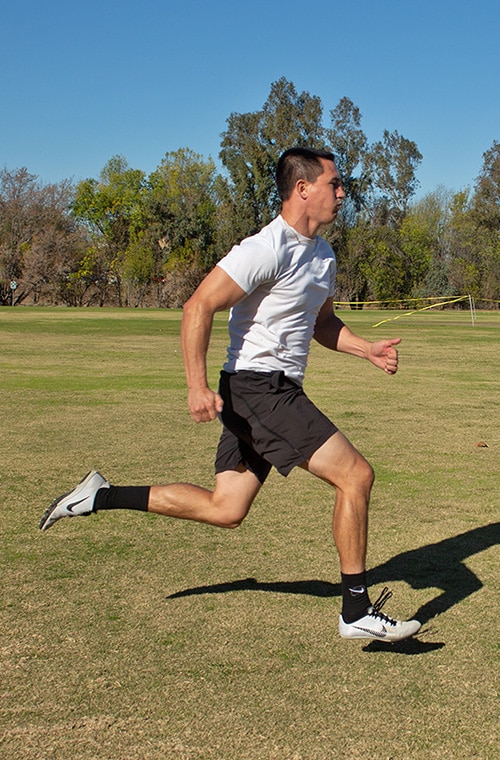
A Performance Lab athlete mid-stride during a build-up run on grass

Build-up runs

Phase 02

Progressive Sprint Training for Beginners

Starting sprint training can be exhilarating, but progressing too quickly can lead to injuries. Building your sprinting foundation gradually helps avoid muscle soreness and other injuries.

Sprint drills, on film

Phase 03

Effective Sprint Drills

Sprint drills are essential for enhancing your sprinting technique and overall speed. Beginners should start with efforts at 70-90% of their maximum speed to avoid overexertion and injuries.

An athlete sprinting on a curve treadmill, with a heart illustration marking the cardiovascular load

Curve treadmill

Phase 04

Curve Treadmill Sprints

Short distance sprints, such as the 60-meter and 100-meter dash, focus on achieving maximum speed and acceleration. The primary components for success in these events include explosiveness and top speed.

Long sprint workout

Phase 05

Long Distance Sprint Workouts

To excel in longer sprints like the 200m to 400m, focusing on speed endurance is crucial. Long sprint workouts emphasize maintaining speed and form under fatigue, which is essential for these distances.

Block starts

Phase 06

Improve Block Start

Interval sprint training is a powerful method for improving speed and endurance.

Strength for sprinters

Phase 07

Incorporating Strength Training

Strength training workouts are a vital component of sprint training, as it helps develop the power and stability needed for effective sprinting.

An athlete drinking water on a park field after a sprint session

Cool down

Phase 08

Cool Down and Recovery

After an intense sprint workout, a proper cool down is essential to aid recovery and prevent injuries.

Close view of a runner's foot contact and trailing leg on a running track

Foot contact, top speed

Phase 09

Common Mistakes to Avoid

Proper form is crucial, especially when running at maximum speeds. A relaxed posture while sprinting prevents injuries and improves efficiency.

Improper form and tensionIncrease injury risks and hinder your progress.

OverstridingCauses strain on your muscles and joints.

See what we find in yours
sprint

We don’t guess. We measure.

Every athlete is timed and filmed before and after. A hand-held stopwatch is off by a tenth or two; the gates are not.

Timing gates

10 m · 20 m · 40 yd

laser, not hand-timed

Motion capture

18 cameras

joint torque without force plates

Head coach

Morey Croson

BS Exercise Science, Biomechanics

Coach’s own 40

4.4 s

22+ mph top speed

Training athletes since

2014

With Morey and the Performance Lab I was able to improve my speed from 15.5mph to 19.8mph in 2 weeks.

Brayden Hagle Athlete

With Coach Morey and Performance Lab I went from running a 7.04 to a 6.68.

Ryan Oh Athlete

Morey’s focus on timing and angles helped me tremendously to improve my running mechanics and 40 time.

Michael Wilson Athlete

What an assessment looks like

From baseline to a plan in 30 minutes.

No guesswork and no generic workout on day one. We observe, measure and prioritize.

01

Assess

Run targeted movements and sprints while the coach records the mechanics that matter.

02

Analyze

Review acceleration, speed and movement efficiency with objective feedback.

03

Build the plan

Get clear recommendations for the highest-impact next steps in training.

Pick a time

Book the assessment.

30 minutes at 17400 Hamlin St, Van Nuys — we time you, film you, and tell you exactly what is costing you speed.

Do not see the time you need?

(818) 578-5013

Not ready to pick a time?

Leave your details and one of our coaches will get back to you about your sprinting assessment.

Prefer to talk first? Call (818) 578-5013.

Thanks — one of our coaches will reach out to you shortly.